EssayAI in data teams4 min
The marginal economics of AI usage
AI productivity follows a marginal-return curve, and judgement is knowing where to stop
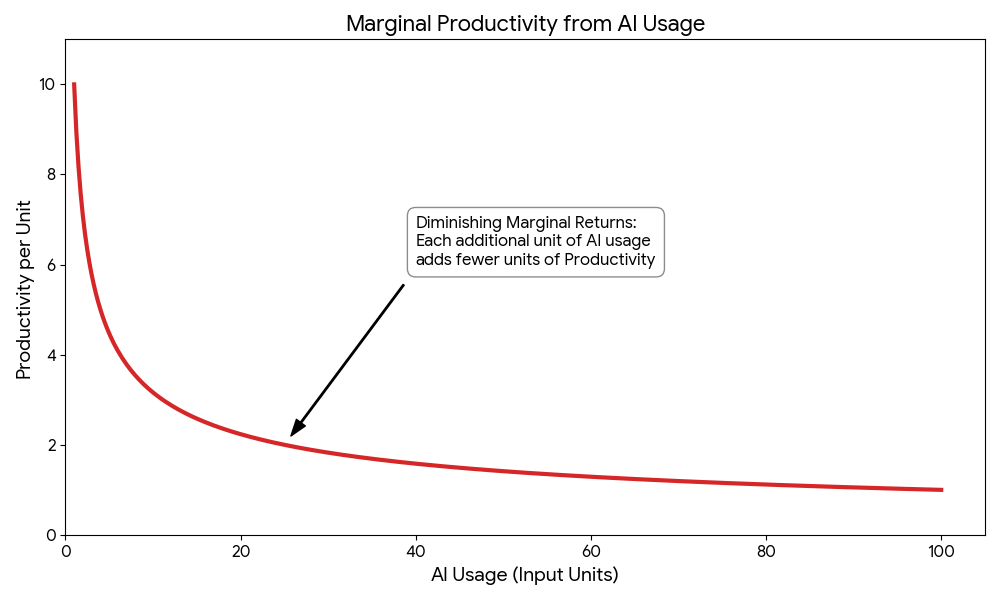
The objective is not to maximise AI usage, but to maximise net value from AI usage; AI productivity follows a marginal-return curve, and professional judgement is knowing where to stop.
Reframing the Objective
The dominant AI narrative still rewards volume: Use it more. Use it everywhere. Use it constantly.
That framing is directionally useful, but economically incomplete. The objective is not to maximise AI usage. The objective is to maximise net value from AI usage.
Once viewed through that lens, AI adoption becomes less of a hype cycle and more of a marginal optimisation problem.
In economics, diminishing marginal returns means each additional unit of input produces less additional output than the one before it. AI usage often follows this exact pattern in real workflows.
Early interactions can produce substantial gains: faster research, quicker first drafts, reduced blank-page friction, and more options to evaluate.
Eventually, interaction can become flat or negative in value once rework, verification, and correction overhead outweigh incremental progress.
This is why mature AI usage is not just a question of high quality prompting. It is also a question of boundary recognition: where are you on the productivity curve, and what is the marginal value of one more interaction?
Iteration Trance
A recurring failure mode appears in this phase: iteration trance.
In an iteration trance, the model rephrases familiar points in increasingly polished language while novelty declines. The process feels productive because there is constant output, but decision quality does not improve proportionally.
This can become a form of informational comfort: motion without meaningful advancement.
What Shifts the Curve
The shape of the curve is not fixed. It is partly structural, and partly designed. It is not enough to identify where your current curve flattens; you can redesign the economics so the curve rises higher and flattens later.
Problem Framing and Context Quality
Clear objectives, constraints, relevant background information, and explicit output criteria improve first-pass usefulness and reduce correction loops. High-quality framing narrows the solution space early, which reduces prompt churn and improves the signal-to-noise ratio of each response. Weak framing and thin context usually push work into iterative clarification, where each additional interaction contributes less net value.
User Domain Expertise
Experts can detect errors quickly, guide model outputs towards usable directions, and integrate outputs into broader systems. Low expertise reduces the scope for using the output productively.
Task Complexity
AI tends to perform best in exploratory and generative phases, where outputs can be iterated quickly and validated with relatively low effort. As tasks become architecture-heavy, safety-critical, or trade-off intensive, uncertainty compounds and each response depends on deeper domain-specific assumptions. In these settings, the curve flattens earlier because more of the work shifts from generation to judgement, integration, and risk management.
Verification Cost
Even when outputs are directionally useful, total value depends on what it takes to establish reliability. In some domains, verification burden can dominate the workflow.
From these variables follows a hard caveat: verification capacity can become a gating constraint. You can still use AI for exploratory learning even when your ability to verify is near zero, and you may learn ideas that are partly or fully valid. But actionable value remains limited until those ideas are validated by human experts or reputable sources.
Consider an example of building an oil rig. AI may provide coherent explanations and guidance on how to build one, but without deep grounding in chemistry, structural engineering, construction systems, and safety regulation, you cannot reliably determine what is sound. The result may feel like progress, yet usable progress arrives only after costly external verification.
Taken together, these factors reinforce a central point: the curve is not purely fixed by the model itself. In many cases, individuals and teams can influence when diminishing returns appear, and can delay or offset them through how work is structured and evaluated. The precise methods will vary by domain, but the strategic implication is clear - curve position is partly a design choice, not just a technical constraint.
Historical and Economic Parallel
This pattern is not unique to AI. General-purpose technologies often deliver outsized early gains, then require tighter optimisation discipline. Electricity transformed factories, but later gains depended on process redesign. Computing created major productivity increases, but eventually faced diminishing returns from over-modelled workflows. Internet access dramatically reduced information costs, then introduced new attention and validation costs.
A broader economic parallel is emerging as well. At a macro level, research discussion has distinguished technical viability from economic viability: many tasks can be implemented with AI, but a smaller subset is economically attractive once implementation and adjustment costs are counted (MIT Sloan).
The same tension appears in product strategy. Unlike classic SaaS economics, where incremental cost per additional user can trend toward near-zero, reasoning-heavy AI systems can still carry meaningful per-request variable costs in the current cycle (State of the Future).
This suggests a useful extension of the core thesis. If individuals must evaluate net value per interaction, product teams may need to evaluate net value per request.
Closing
The central idea remains simple: maximising AI usage volume is the wrong target metric. The more durable objective is maximising net value under real economic constraints.
Related
Writing code was never the job
AI is changing how engineers deliver, not what they're paid for
EssayAI in data teams